How to Plan a Peacefully Productive Week in 5 Simple Steps
Keep reading this post to learn:
The 5-step process I’ve used to plan my weeks for more than 6 years
How to create a weekly plan that prioritizes your responsibilities, goals, mental health, and relationships
Why I use both Google Calendar and a paper planner to organize my life
If your weeks feel like an overflowing suitcase that you have to sit on to zip, you’re not alone 🤪
If we’re honest, most of us try to cram way too much into seven days, then wonder why we already feel drained by Wednesday.
We all know that we can’t create more time. But we can create more space by pruning what doesn’t matter and planning what does with intention.
I’ve been using the same five steps to plan my weeks for more than six years, and this rhythm has supported me through all kinds of seasons:
Becoming a new entrepreneur
Pregnancy
Postpartum and maternity leave
Life as a working toddler mom
What fills my weeks has ebbed and flowed, but the five-step process I use during my Weekly Prep Meeting has stayed the same!
Annie Dillard famously wrote, “How we spend our days is, of course, how we spend our lives.”
Amen, Annie 🫰🏼.
The way we spend our hours eventually becomes the way we spend our lives. A schedule gives our days some structure and helps protect them from unnecessary chaos.
That doesn’t mean every hour has to go according to plan. It means we’re choosing to be intentional about how we show up for what matters most!
Here is the exact five-step process I use to plan a peacefully productive week.
Before You Start: Choose a Consistent Planning Time
Before we get into the five steps, choose a consistent day and time for your Weekly Prep Meeting.
Doing it at roughly the same time every week helps the meeting become part of your normal rhythm instead of another task you have to remember.
I personally plan my week on Thursdays because Thursday is my last workday of the week. When I sit down in my office at 10:00 AM, it’s the first thing I do!
My meeting takes around ~15 minutes now, and it’s one of the best investments I make with my time. Having a game plan saves me so much time and energy throughout the following week because I’m not waking up and winging it every day.
If you’re new to weekly planning, give yourself 30–45 minutes at first. You’ll become faster as the rhythm becomes more familiar.
And remember: schedules and routines are tools, not chains 🫶
The goal isn’t to expect your week to unfold perfectly. It’s to be as intentional with your time as possible so you can feel proud of how you’re showing up!
Plus, it’s much easier to pivot from a plan than it is to figure everything out from scratch every day.
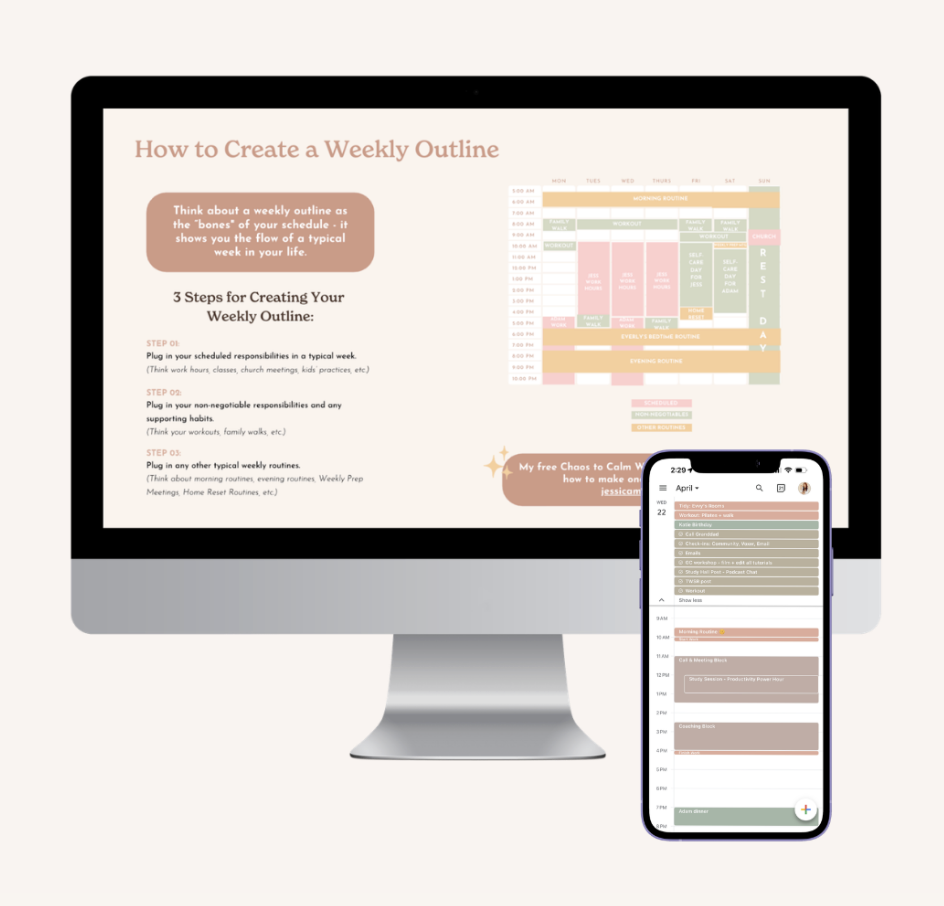
Step 01: Add Your Time-Bound Responsibilities
Start by adding everything that has to happen at a specific time.
This might include:
Work hours
Classes
Appointments
Church
Meetings
School events
Kids’ practices or activities
These responsibilities form the basic structure of your week because they are the least flexible pieces.
I like to highlight all of my work commitments in one color and my personal commitments in another. This lets me quickly see what kind of week I’m walking into and where most of my energy will be going.
Once these responsibilities are visible, you have a much more realistic picture of the time and capacity you actually have available!
Watch this blog post on YouTube!
Step 02: Add Your Non-Negotiable Priorities and Habits
Next, add the habits and priorities that support the way you want to feel and show up.
These might look like:
Journaling
Workouts
Daily movement
Tidying
Family walks
Quiet time
Meaningful time with people you love
In my Peacefully Productive Planner®, I use the habit tracker for my daily movement, tidying, and some of my “kind thing for myself” and “kind thing for someone else” habits.
These habits are part of the Hustle Sanely 5, which are five daily habits that help us live peacefully productive lives.
This step matters because your priorities need a place in your real schedule.
It’s easy to say that your mental health, relationships, or movement matter to you. But if your entire week is filled with responsibilities and tasks before you consider those things, they will probably keep getting pushed to “if I have time.”
Planning them now makes them part of the week instead of an afterthought.
Step 03: Choose and Schedule Your Weekly Top 3
Now, determine the three most important tasks you want to complete that week.
I call these your Weekly Top 3!
Your Top 3 can be a mix of personal and professional tasks. They aren’t necessarily the only things you’ll do. They are the three things that deserve your clearest focus because completing them would make the week feel meaningful or successful.
Once I choose mine, I assign each task to a specific day using the daily Focus 3 section in my planner.
This step helps prevent a giant weekly to-do list from becoming a cloud of pressure that follows you around all week.
Instead of thinking, “I need to do all of this at some point,” you’re deciding when your most important tasks will receive your attention.
You aren’t trying to make progress on everything at the same time. You’re identifying what matters most and giving those tasks a realistic home.
Step 04: Plan Your Rest
Yes, rest belongs in your weekly plan 🙂↔️
We do not earn our rest! We operate from a place of rest!
If you wait until every task is finished, every message is answered, and every area of your home is perfectly tidy before allowing yourself to rest, you will probably never get there.
There will always be something else you could do.
That’s why I decide what rest will look like and when it will happen. I schedule it like an appointment.
Your weekly rest could be:
Reading for an hour
Taking a nap
Watching a movie
Spending a slow evening at home
Going on a walk without listening to anything
Enjoying time with your family without multitasking
Rest doesn’t have to look the same every week, but it does need to be considered before your calendar gets packed.
When you plan from a place of rest, you’re building a week that supports your humanity instead of treating yourself like a machine.
Step 05: Add Other Tasks While Protecting Margin
Finally, brain-dump any additional tasks that need to be completed that week.
If I already know which day I’ll complete a task, I add it to that day’s Focus 3 section. If I’m not sure yet, I add it to the “Other Tasks” list in my weekly planner.
Pssst: As you do this, be careful not to fill every open space!
Leave room for:
Transitions
Tasks taking longer than expected
Unexpected needs
Breaks
Real life being real life
Margin is not wasted time. It is what helps your schedule remain functional when something changes 👏🏼
A peacefully productive week is not one where every minute is occupied. It’s one where your plan reflects your priorities and has enough flexibility to support your actual life.
Why I Use Google Calendar and a Paper Planner
People often ask why I use both Google Calendar aaand a paper planner 🤔
The honest answer is: it’s what works best for my brain.
The best planning system is the one you’ll actually use!
I use Google Calendar as a placeholder for scheduled events and recurring tasks in both my work and personal life. Think of those events as digital sticky notes that hold information I don’t want to keep in my brain.
Then, I use my weekly paper planner to create a specific game plan for each week.
My Google Calendar shows me what is happening. My planner helps me decide how I want to move through it.
The planner is my working plan. It helps me prioritize my mental health and relationships while I pursue my goals.
If you want a closer look at my digital system, I created a Google Calendar Masterclass that walks you through exactly how I organize my personal and professional tasks and events in one place.
Your Weekly Plan Is Allowed to Change
Planning your week is not about controlling every minute or guaranteeing that nothing unexpected will happen.
Your child may wake up sick.
An appointment may get moved.
A task may take much longer than you expected.
Your energy may simply be different from what you anticipated.
But that doesn’t mean your plan failed.
Your schedule is a tool that gives you a thoughtful starting point. When life changes, you can look at the plan, adjust your priorities, and pivot without rebuilding the entire week from scratch!
That’s peaceful productivity: creating enough structure to support what matters without making the structure another source of pressure 🕊️
Schedule Your First Weekly Prep Meeting
Your homework is to schedule a Weekly Prep Meeting to plan next week! 👩💻
If this is a new rhythm for you, give yourself 30–45 minutes to work through the five steps:
Add time-bound responsibilities.
Add non-negotiable priorities and habits.
Choose and schedule your Weekly Top 3.
Plan your rest.
Add other tasks while protecting margin.
And make it a vibe, so you’re actually excited to show up!
Light a candle, put on a playlist or ambience video, and make a fun drink. May I recommend a Shirley Temple Poppi or an iced salted honey latte? 👀
With practice, your Weekly Prep Meeting may only take around 15 minutes. But even if it takes longer, it is time well spent.
A few intentional minutes now can save you from using precious energy to make the same decisions over and over throughout the week!
Ready to Plan Your Week with Intention?
Our 2026 Peacefully Productive Planner® is currently marked down to $25, which is more than half off!
There are still four solid months left in the year. If you’ve been wanting to try the Hustle Sanely Planning System™, this is the perfect opportunity.
And speaking of planners, our 2027 collection launches in September with a brand-new horizontal weekly spread! Eeeek! 🤸♀️
If you want to be the first to know when the collection drops, make sure you’re on the Hustle Sanely email list.
We also send Slow Down Saturday every week with peaceful productivity inspiration and all the latest things happening in the Hustle Sanely community! See ya there!
Links Mentioned:
📲 Did you find this helpful? Screenshot this post, share it to your IG stories, and tag @jessmmassey and @hustlesanely so we can cheer you on!
Take our community favorite Google Calendar Masterclass to learn how to set up your Google Cal for a peacefully productive life!
Loved this blog post? Tune into the full podcast episode below!