The 4-Part Framework That Makes Parenting a 3-Year-Old More Manageable
Keep reading this post to learn:
Keep reading this post to learn:
The simple framework helping me navigate tantrums and big feelings
Why emotional outbursts are a normal part of a 3-year-old’s development
How we use visual tools to make transitions and routines easier
The ways we’re building a family culture rooted in connection and communication
If you’re parenting a 3-year-old right now and regularly wondering, What in the actual world is happening?! …this post is for you.
Let me start by saying that I am so far from a parenting expert that it’s not even funny, lol. I have a 3½-year-old, and my husband and I are truly figuring out this whole parenting thing as we go.
You can read parenting books, take courses, and save all the Instagram posts, but at some point, you have to do the dang thing in real time and figure out what works best for your child and family.
I had always heard about “the terrible twos,” even before becoming a mom. But truthfully, the twos were fairly straightforward for us. I remember thinking, Oh, okay…this is the terrible twos? Amazing! We’ve got this.
Then my sweet angel daughter turned three and, excuse my language, but all hell broke loose, y’all. 😳
It felt like a switch flipped overnight. Suddenly, she was pushing boundaries, not listening, and having huge emotional reactions over things like receiving the wrong cup, having her snack opened incorrectly, or us putting her blanket on the wrong way.
My husband and I spent a couple of months flailing, trying different approaches, and throwing things at the wall to see what would stick. Nothing felt consistent or particularly helpful.
Then my best friend and I started talking about how easy it is to say or do things we aren’t proud of in the heat of the moment when we don’t have a rhythm to follow.
There have been plenty of times when I’ve tried to discipline Everly, and by discipline, I mean teach, from my own completely dysregulated state. Then I’ve had to go back, apologize, and try again because I wasn’t proud of how I handled the situation.
Y’all know my brain loves a framework. Frameworks help me stay emotionally regulated and make decisions from a more grounded place instead of going off the rails.
So naturally, I created one for this season of parenting. I call it:
The 4 Cs to Handle the 3s
Before I walk you through the framework, here are a few reminders that have brought me comfort during this season.
A Few Reassuring Truths About 3-Year-Olds and Big Feelings
01: Tantrums are developmentally normal
Tantrums are a normal part of early childhood development and are especially common during the toddler and preschool years. Some children have more than others because every child has a different temperament.
I remind myself almost every day: She literally does not have a fully developed brain yet.
02: Knowing the words for feelings doesn’t mean they can regulate them
Three-year-olds are developing language skills quickly. They might be able to tell you that they’re frustrated, disappointed, or angry, but that doesn’t mean they can manage those emotions independently.
Their emotional regulation skills are still very much under construction.
03: A meltdown isn’t necessarily manipulation
When young children become overwhelmed, they can genuinely lose the ability to regulate themselves. They aren’t always intentionally choosing to behave badly.
Sometimes, they need our help returning to a calmer state before they’re able to listen, learn, or problem-solve.
04: The goal isn’t to eliminate big feelings
The goal is to gradually teach our children what they can do with those feelings.
Your 3-year-old can have a huge vocabulary, impressive reasoning skills, and very strong opinions while still having a nervous system that needs help regulating.
And that’s where the 4 Cs come in:
Call out what’s happening
Co-regulate
Correct the behavior
Connect
Let’s talk about what each step looks like in real life!
01. Call Out What’s Happening
I begin by calmly narrating what’s happening.
This helps Everly learn how to recognize and verbalize her feelings, and it gives me a second to compose myself before responding.
Let’s say she’s stomping her feet and yelling because she doesn’t want to clean up her Magna-Tiles and go brush her teeth.
Calling out what’s happening could sound like:
“It seems like you’re frustrated because you want to keep playing. I get it, sometimes I want to keep doing something when it’s time to move on, too. But it’s time for us to brush our teeth now. Do you want to walk to the bathroom, or do you want me to carry you?”
I acknowledge the feeling, hold the boundary, and give her two acceptable choices.
If she doesn’t choose, I choose for her and calmly carry her to the bathroom.
02. Co-Regulate
Before trying to correct or teach anything, I help her calm her body, and usually mine, too.
We can’t productively parent when we’re triggered or dysregulated. Our kids can’t learn when they’re dysregulated, and we can’t calmly teach or correct them when we’re in that state, either.
Sticking with the same bedtime example, once we’re in the bathroom, I might sit on the floor and play patty-cake with her or turn on one of her favorite songs for a quick dance party.
If I try to lead her through breathing exercises like, “Take a deep breath and blow out the candle,” she looks at me and says, “No, I don’t want to,” lollll.
I’ve learned that she regulates best through movement, so I choose activities that help her move her body.
The goal isn’t to distract her from the boundary. The boundary is still there. We’re simply helping her body reach a state where she can receive it.
03. Correct the Behavior
Once everyone is calmer, I hold the boundary and remind her of the expectation.
After our little 30-second dance party, I’ll brush her teeth and then have a short conversation with her.
I might ask:
“What kind of girl are you?”
She responds:
“A kind and respectful girl.”
That’s something we’ve intentionally taught her because I love reminding her who she is.
Then I’ll say:
“Yes, you are a kind and respectful girl! What do we do in our house when Mom or Dad asks us to do something?”
She’ll respond:
“Listen the first time.”
Then I connect the expectation to what just happened:
“That’s right, good remembering! When I tell you it’s time to stop playing with your Magna-Tiles and brush your teeth, what do you do?”
She’ll say something like:
“Stop playing and go brush my teeth.”
Then we go back and practice the situation again. When she demonstrates the expected behavior, I enthusiastically affirm it:
“OMG, YES! Amazing! What a good first-time listener you are!”
Instead of only focusing on the behavior I don’t want, I make a big deal about affirming the behavior I do want.
05. Connect
I think it’s so important to wrap up these moments with connection.
Connection builds trust and reinforces that our relationship is safe, even when we have hard moments or communication breakdowns.
I’ll give her a hug, tell her I love her, and remind her how much I love being her mom.
I want her to know that my love for her doesn’t disappear when she has a tantrum, makes a mistake, or needs correction. My love for her is unconditional.
Those are the 4 Cs I lean on when I’m parenting through a difficult moment:
Call out what’s happening.
Co-regulate.
Correct the behavior.
Connect.
Does this play out perfectly every time? Absolutely not.
This framework is a tool, not a chain, just like everything else I teach.
The point is to help me feel proud of how I’m showing up as a mom and to bring more consistency to how I respond.
When we’re winging it from moment to moment, we might respond gently one time and completely lose our cool the next. That lack of consistency can be confusing for our kids and emotionally draining for us as parents.
This framework takes away some of the guesswork. Instead of scrambling to decide how I’ll respond, I have four simple steps to follow.
And sometimes, I’m exhausted or at my wit’s end, and I still snap. When that happens, I pause, apologize, and try again.
Parenting is truly a practice if you ask me, lol.
Using Visual Tools to Support Routines and Transitions
The 4 Cs help us navigate difficult moments, but we also use visual tools to prevent some of those moments and make daily transitions easier.
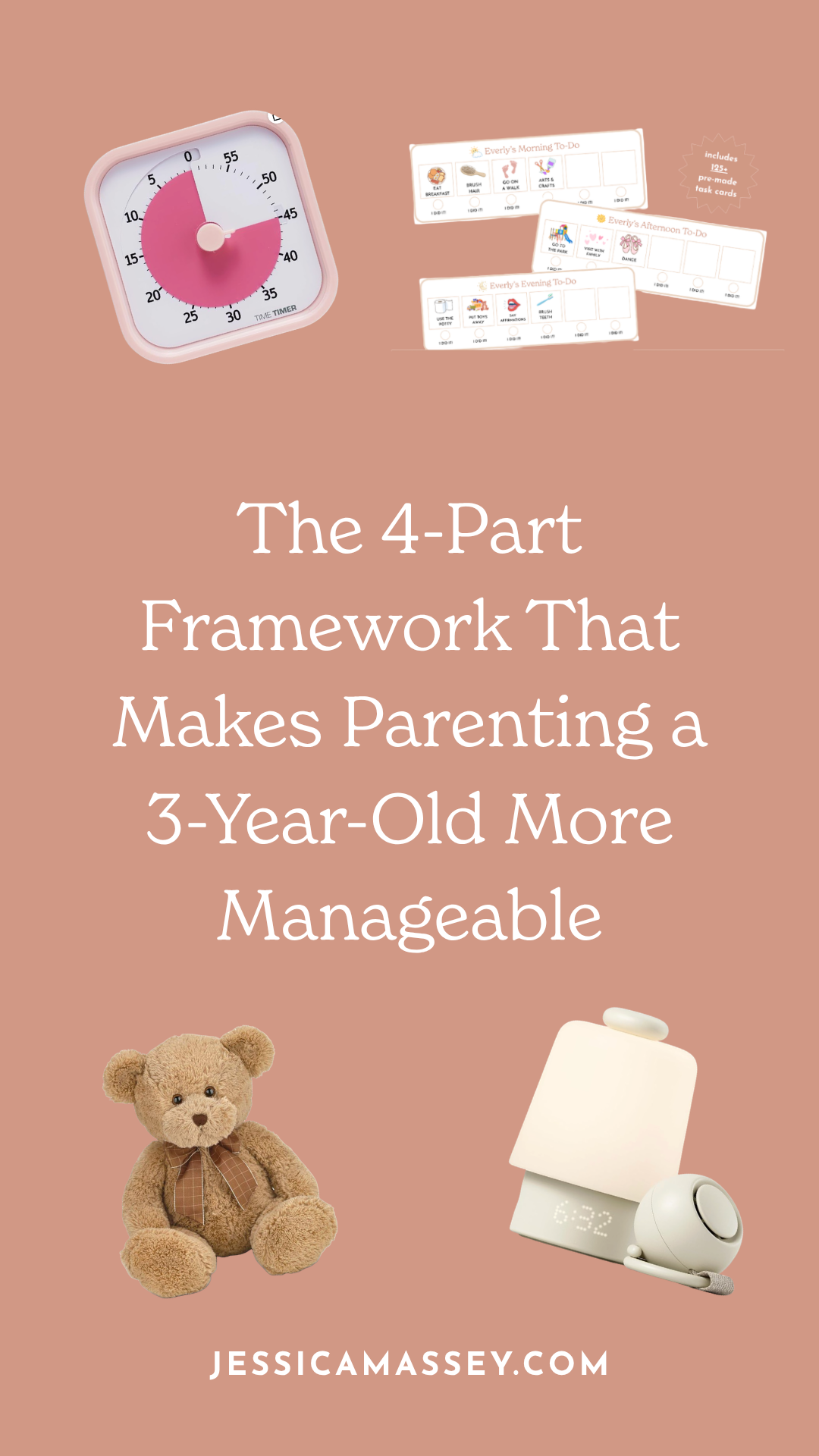
The three tools that support us most are a visual timer, our Hatch sound machine, and a daily routine chart.
Visual Timer
We use timers for basically every transition.
The timer we use has a colored circle that gradually disappears as the time counts down. This allows Everly to visually understand how much time is left before we need to move on to something else.
It gives her a warning before the transition, and it lets the timer be the “bad guy.”
Instead of surprising her by abruptly ending playtime, I can say:
“Ope, the timer went off! It’s time to put away our toys and brush our teeth before bed.”
Honestly, y’all, it’s kind of magic because she rarely argues with the timer.
The timer is basically the king of our household at this point, lol.
Hatch Sound Machine
We’ve had our Hatch sound machine since Everly was born. We love it for the actual sound-machine function, but now we also use its colored lights to communicate expectations.
You can create programs in the Hatch app so that the light automatically changes colors at specific times.
When Everly goes to bed, the Hatch turns red. She knows:
When it’s red, stay in bed.
At 7:00 AM, the light turns green, which means she can come out of her room.
This took some training and a lot of consistent boundary-holding at first, but it was so worth it. Now she understands and follows the routine without questioning it.
Daily Routine Chart
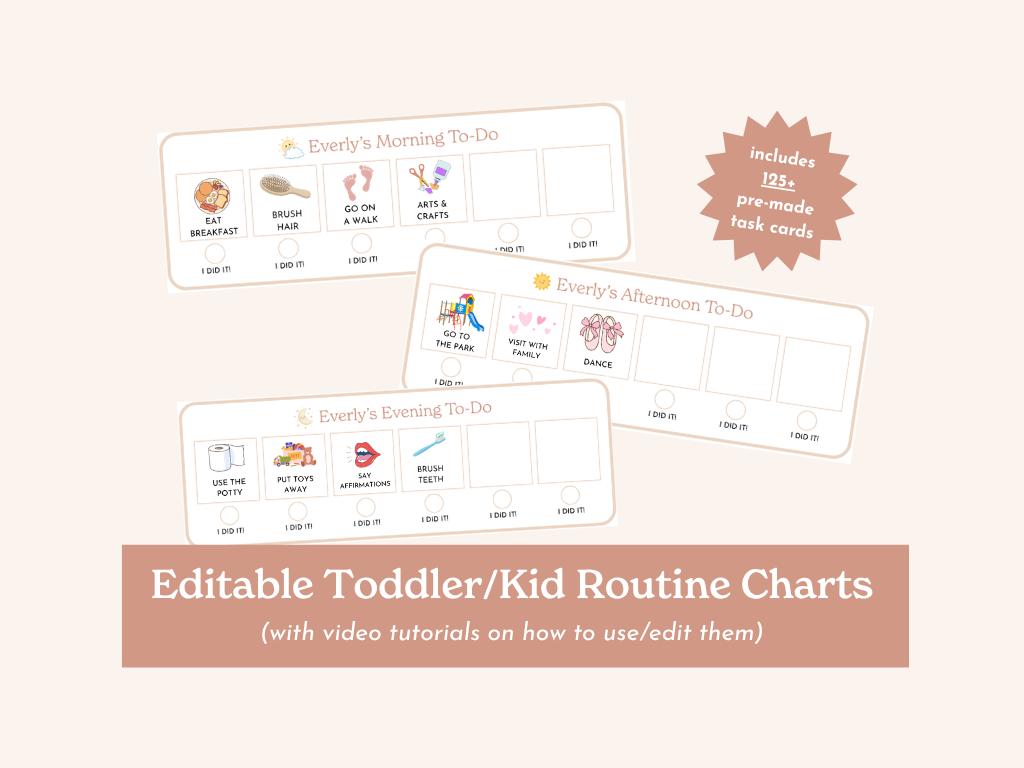
I created an editable Daily Routine Chart that we keep on our refrigerator.
It includes three separate sections:
Morning to-dos
Afternoon to-dos
Evening to-dos
Each task has a picture and written label, along with a little bubble that Everly can check off when she completes it.
The chart is editable, so I can swap the task squares using Velcro dots. Every night before bed, I update it for the next day. It takes around 30 seconds.
I love it because Everly knows what to expect from her day—and we all find comfort in knowing what to expect.
It also gives her a sense of independence and helps her take age-appropriate ownership of her routines.
For example, her morning chart might say:
Use the potty
Brush teeth
Get dressed
Say gratitude
Put toys away
Go to school
Her afternoon chart might say:
Use the potty
Check the mail
Water the basil
Read a book
And her evening chart might say:
Clear the table
Use the potty
Take a bath
Tidy room
Say affirmations
Brush teeth
She can look at the chart and understand what she’s responsible for without us verbally repeating every step all day long.
Building a Family Culture Through Our Words
The final thing helping us navigate this season is being intentional about how we communicate as a family.
I grew up in a home where communication didn’t really exist. No one talked about anything, and everyone was kind of on their own island.
There’s a quote I’ve seen on social media that resonates deeply with me:
“I’m a former bedroom kid trying to raise a living room kid.”
I want our family to be close-knit. I want us to be good communicators. I want our home to feel like a safe place where we can talk about what we’re feeling and work through difficult things together.
I’m also a big believer in the power of our words, and I want to instill that in Everly.
Since she could talk, we’ve taught her that being part of our family means being kind and respectful. If you ask her, “What kind of girl are you?” she’ll tell you, “A kind and respectful girl.”
Of course, we also talk about what those words mean and what they look like when lived out.
We’ve also practiced bedtime affirmations with her since she was able to speak. She says:
I am kind.
I am beautiful.
I am smart.
I am safe.
I am seen.
I am loved.
I am fearfully and wonderfully made.
We’re currently working on another project that I’m so excited about: writing our family values and house rules.
Once we’ve decided on them, I’m going to create a cutie little poster to display in our home so we can all see and practice them regularly.
Create Your Own Family Operating Manual
Writing our family values and house rules is actually part of what we’re doing during the Fall Semester of Hustle Sanely Study Hall!
Our October–December topic is: Creating a Peaceful Home Life 🏠🧺🕊️
Together, we’re designing personalized family operating manuals that bring more connection and intention into our everyday lives.
We’ll be working through things like:
Clear family values
Sustainable chore systems
Meaningful traditions
A meal rhythm that works
Routines that support the family culture we want to create
LIKE, ARE YOU KIDDING ME?!
By the time we wrap up the semester in December, we’ll each have a family operating manual customized to our own homes. I don’t think I’ve ever been more excited about a Study Hall topic!
If you’ve never heard of Hustle Sanely Study Hall, it’s a community-based coaching membership of more than 300 women. It’s designed to help you turn your good intentions into real-life habits so you can show up well for your goals, your people, and yourself.
Enrollment is only open four times a year, and October 1–7 is the final enrollment period of 2026.
Learn more about Study Hall here and see if the community feels like a good fit for you. We’d love to have you!
A Reminder for the Hard Parenting Days
Parenting a 3-year-old is no joke.
It requires so much patience, consistency, and emotional energy. But y’all, we were each chosen to be the parents of our children. We are equipped and capable of learning how to show up well for them.
Parenting is hard, but it’s one of those hard things that is incredibly worth it.
The more consistent we are, the more opportunities we have to watch the seeds we’re planting every day begin to bloom.
That’s what I remind myself on the days when it feels like nothing I’m saying or doing is sticking. The more seeds I plant and water, the more opportunities they have to grow.
Mama, we’ve got this 🫶🏻
Links Mentioned
📲 Did you find this helpful? Screenshot this post, share it to your IG stories, and tag @jessmmassey and @hustlesanely so we can cheer you on!
Grab Our Community-Favorite Toddler/Kid Editable Routine Chart!
Loved this blog post? Tune into the full podcast episode below!