Why Procrastination Has Nothing to Do With Laziness (and Everything to Do With Your Emotions)
Keep reading this post to learn:
The definition of procrastination that will change how you see yourself
Why your brain treats your future self like a stranger (rude???)
Why “productive procrastination” isn’t better than scrolling, it’s still procrastination!
3 core reasons you procrastinate (and what to do instead)
I genuinely don’t know one single person who doesn’t deal with procrastination. Even the most disciplined people I know still have moments where they put something off.
And here’s what I think is the worst part: procrastination doesn’t just delay tasks… it steals time from the things you actually care about.
You procrastinate, so the task takes longer than it needs to. Then you have less time for self-care, hobbies, rest, or being present with your people. And that honestly sucks.
We talk about procrastination like it’s a personality flaw, like we just need more discipline, more motivation, more willpower.
But before we start beating ourselves up, I want to zoom out and reframe what procrastination actually is.
One definition stopped me in my tracks:
Procrastination is choosing short-term emotional relief over long-term progress.
Read that again. Because whew.
That means you’re not avoiding the task, you’re avoiding how the task makes you feel.
And suddenly, procrastination makes a lot more sense!
Procrastination Isn’t Always Obvious (Sometimes It’s “Productive”)
Procrastination comes in all shapes and sizes.
Some people procrastinate by scrolling TikTok for an hour.
Other people (hi, hello) procrastinate in a way that looks productive, like suddenly deciding it’s the perfect time to reorganize the spice cabinet or declutter an entire closet.
But here’s the thing: one isn’t better than the other.
Because either way… the deadline is still looming, the task is still undone, and the stress is still living in your brain rent-free.
And when you have a lingering task that you keep pushing off, it doesn’t stay contained to “just that task.”
It affects everything.
You might feel more irritable. More anxious. More mentally “on.”
You might be short with your partner, distracted when you’re with your kids, and unable to fully rest at night because guilt keeps tapping you on the shoulder like, “Hey bestie… remember me?”
So when we procrastinate:
the task isn’t getting done
and our peace is taking a hit
It’s a lose-lose. Which brings us to the real question: Why do we keep procrastinating… and how do we stop?
Let’s talk about three common reasons procrastination shows up — and how to respond in a peacefully productive way.
Reason #1: You’re Fighting Your Energy Instead of Working With It
One of the biggest reasons procrastination shows up is because we’re trying to do the right work at the wrong time.
We’ve been taught that productivity is about pushing through no matter what, regardless of how we feel.
But your brain and body don’t run on a flat schedule.
Your energy naturally rises and falls. Your focus shifts. Your mental clarity isn’t consistent all day long… and that’s not a flaw. That’s biology. We are not machines 🤖
So when you try to do deep, mentally demanding work during a low-energy window, your nervous system can feel overwhelmed.
And when overwhelm shows up? Procrastination is usually right behind it.
This isn’t laziness. It’s capacity!
What Helps: Plan Around Your Energy Zones
Instead of asking, “When do I have time to do this?” try asking:
“When do I have the right energy to do this?”
Start noticing patterns:
When do you feel most clear-headed?
When do ideas come easily?
When do you have the best focus?
When does everything feel heavier and slower?
Then match tasks accordingly.
High-focus work deserves your best energy — not your leftovers.
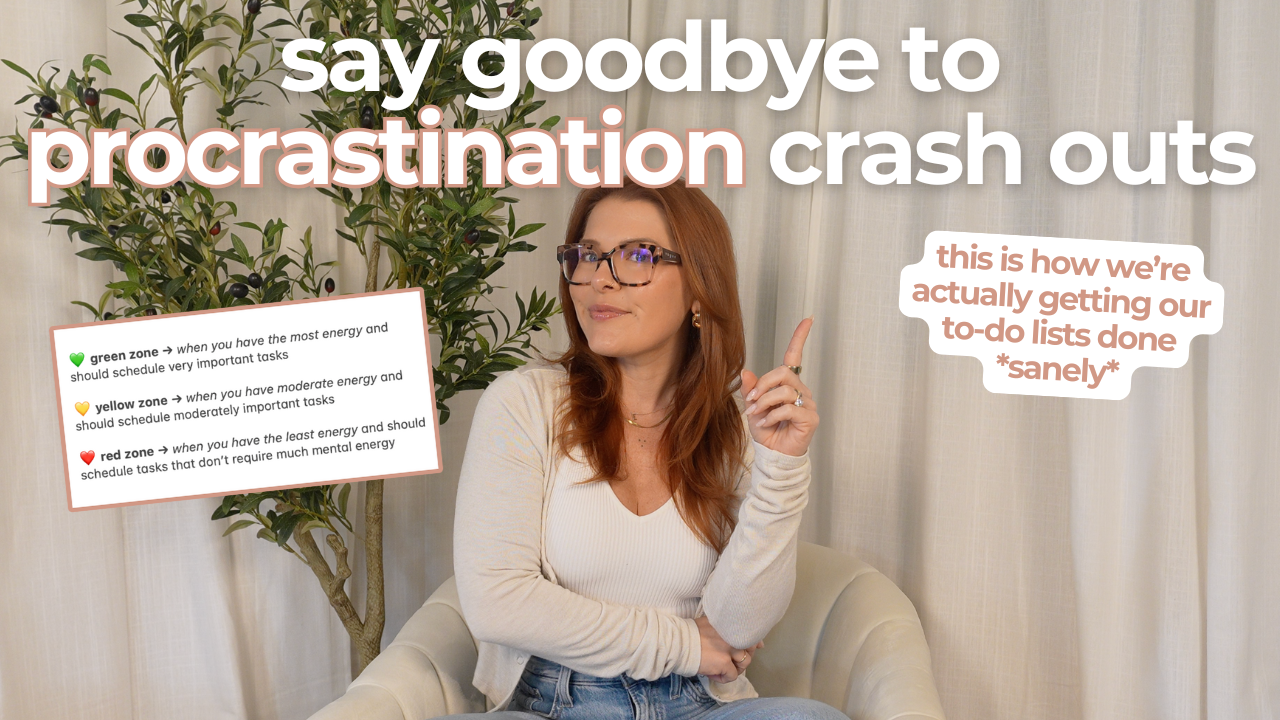
A simple framework for this is the Green / Yellow / Red Zone method (from At Your Best by Carey Nieuwhof):
Green Zone: high energy → big tasks / deep work
Yellow Zone: moderate energy → medium tasks
Red Zone: low energy → admin, draining, small tasks
When your schedule supports your energy, procrastination naturally decreases because you’re no longer forcing yourself uphill all day!
Visual Learner? (Same!) Watch This Blog Post on YouTube!
Reason #2: Your Tasks Are Too Big, Vague, or Overwhelming
Another common reason procrastination happens: the task is unclear or way too big.
When your to-do list says “work on project” or “figure this out,” your brain doesn’t know where to start.
And when the starting point is unclear, avoidance feels safer than guessing wrong.
Your nervous system loves clarity. Defined edges. A clear next step.
When a task feels like a giant blob of responsibility, your brain goes, “Nope. Let’s open Instagram.”
Again: not laziness. Not a character flaw. Just a task that hasn’t been translated into something doable yet.
What Helps: Shrink the Task Until It Feels Neutral
Instead of asking yourself to tackle the whole mountain, ask:
“What is the smallest meaningful step I could take right now?”
Think in actions, not outcomes.
Outcomes feel huge. Actions feel manageable.
Example: “Look for a new job” is overwhelming.
Shrink it into:
Update resume
Draft cover letter template
Practice interview questions
Even better? Shrink it again:
Update your resume header + current job title
Write one paragraph for your cover letter
Answer three common interview questions in your notes app
When your brain knows exactly what to do next, procrastination has a harder time hijacking you.
Reason #3: You’re Trying to Power Through Instead of Listening to the Resistance
A lot of us were taught that when we procrastinate, the solution is to try harder.
More pressure.
More discipline.
More self-criticism.
But procrastination isn’t usually a motivation issue. It’s an emotional one.
Underneath procrastination, there’s often something like:
fear of messing it up
fear of being judged
fear of failing
fear of realizing you don’t actually want the thing anymore
And when we ignore that emotional layer, we create even more internal tension.
What Helps: Get Curious About What Feels Uncomfortable
Instead of forcing yourself forward, pause and ask:
“What feels uncomfortable about this task right now?”
Not in a spiraling way. Not in a dramatic way. Just honest.
If you’re avoiding applying for jobs, write: “Why am I avoiding applying to new jobs?”
Then sit still for 30–60 seconds and write what comes up.
Maybe it’s:
“I don’t feel qualified.”
“I don’t know what I want.”
“I’m scared of being judged.”
When you name the fear, it loses power.
Awareness creates space.
Space creates relief.
Relief makes action accessible again.
And that’s what peacefully productive living looks like: Working with yourself, not against yourself!
Your Homework: Map Your Energy Zones
Before next class, determine your:
Green zone hours
Yellow zone hours
Red zone hours
And a reminder: your zones can change by season (especially if you’ve become a mom, changed jobs, or your schedule shifted). Even if you’ve done this before, it’s worth revisiting.
Because when you plan around your energy, procrastination doesn’t stand a chance 🫶
Want More Support?
📖 Read this NYT Article
🎧 Listen to Episode 307 of the Hustle Sanely Podcast
🎥 Watch the full episode on YouTube
🛍️ Get your 2026 Peacefully Productive Planner
✨ Get $10 off a Brick
📲 Did you find this helpful? Screenshot this post, share it to your IG stories, and tag @jessmmassey and @hustlesanely so we can cheer you on!
Shop our planners & journals designed to help you trade burnout for a peacefully productive life ☁️✨

Loved this blog post? Tune into the full podcast episode below!